The Best Gift Cards for Collectors: 12 Picks That Will Not Get Re-Sold
I have talked to a lot of collectors over the years, and they all tell a version of the same story about a well-meaning relative.
Somebody’s aunt knows they collect comics, so she buys them a comic. It is the wrong series, or a reprint, or issue 4 of a run they already own complete, and it came in a plastic clamshell that a collector would never store anything in. The collector says thank you sincerely, because the thought was real, and then the thing sits in a closet forever.
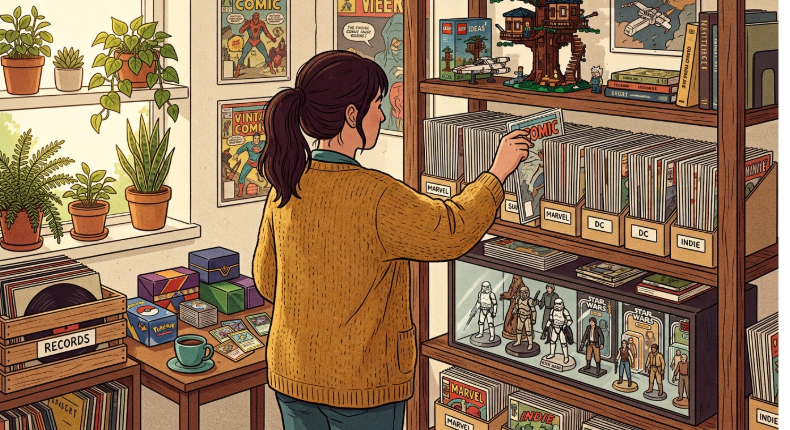
This is the central problem with buying for collectors. It is not that we are ungrateful or snobby. It is that collecting is fundamentally about specificity. The whole hobby is knowing exactly which one you need next, and there is no way an outsider can know that.
A gift card fixes it completely. You are not opting out of thoughtfulness. You are recognizing that the thoughtful part is knowing what shop they go to, and letting them handle the rest.
Here are the 12 I would put in front of any collector I know, sorted by what they are into.
| THE SHORT ANSWERThe best gift cards for collectors are the ones tied to where they already shop, because collecting is highly specific and buying the item yourself usually misses. A local comic shop or card shop is the most personal pick and supports the place they actually go. For LEGO, buy direct, because exclusives and retiring sets are only available there. For vinyl, a record store. For video games, confirm the platform first. eBay and Whatnot work for collectors chasing individual pieces on the secondary market. If you do not know what they collect or where they buy, a flexible card avoids the guess. $25 to $50 covers a nice addition, and $100 or more is appropriate for LEGO, graded cards, and anything the collector considers a grail. |
Why you should not buy the actual thing
I want to make this case properly, because everyone’s instinct is that a gift card is the lazy option and in this category it is genuinely not.
Collections have gaps, and the collector knows exactly where they are. They also usually know current market prices better than any retailer’s shelf tag, which means they can tell instantly whether something was a good buy. That is an awkward thing for a gift to carry.
Condition is the other issue, and it is where most gift purchases fall apart. In comics, cards, and figures, condition is most of the value. A well-meant purchase of a beat-up copy, a repacked figure, or a card in a soft sleeve rather than a rigid holder is not a smaller version of the right gift. It is a different item entirely.
And then there is the thing nobody says out loud: a lot of collectors quietly resell or trade gifts that miss, and then feel guilty about it. A card removes the whole awkward chain. Nobody has to pretend.
| DID YOU KNOW?The single most useful question you can ask a collector is not what do you collect. It is where do you buy. Collectors almost always have a specific shop, a specific online seller, or a specific platform they are loyal to, often because of a relationship with the person running it. Knowing the store is more actionable than knowing the hobby, and asking the question is not a spoiler, because they will assume you are just making conversation. They will happily talk about it for ten minutes. |
The 12 best gift cards for collectors
1. Their local comic shop (the most personal pick here)
If your person reads comics, this is the card, and it beats any national retailer by a wide margin.
Most comic readers have a pull list, which is a standing order the shop holds for them each week. A card at their shop goes straight against that, plus back issues, trade paperbacks, and the omnibus editions they have been eyeing and cannot justify at $125.
There is a community angle too. Local comic shops operate on thin margins and a lot of them have been through a rough decade. Buying a card there supports a small business your person genuinely cares about, and the shop owner will almost certainly mention it to them, which is its own nice moment.
Best for: comic readers, and gifts of $50 or more.
2. A local card shop or breaker (for the sports and TCG crowd)
Trading cards have gone through an enormous surge, and the hobby splits into several distinct groups that need different things.
Sports card collectors want boxes, singles to complete a set, and supplies. Pokemon and Magic players want sealed product and singles for a deck, and those are almost different hobbies from each other. A local shop covers all of it and usually runs the events where people actually play.
One honest caution: if your person is a set builder chasing specific cards, sealed packs are a worse gift than the card lets on, because packs are essentially lottery tickets. A card lets them buy the single they actually need rather than gambling. Let them decide which they want.
Best for: sports card and TCG collectors, and gifts of $50 to $150.
3. LEGO (buy direct, and here is why it matters)
LEGO collecting is a serious adult hobby and the gift card has a specific advantage that people outside it do not know about.
Sets retire. Permanently. When a set leaves production it does not come back, and the aftermarket price on a retired set can climb well past retail. Serious builders track retirement lists and buy before things disappear, which makes timing part of the hobby.
Buying direct also gets access to exclusives that big-box stores do not carry, plus the gift-with-purchase promotions that only run on the official store. So a LEGO card is meaningfully more useful than the same amount at a general retailer, which is not true for most brands.
Best for: adult LEGO builders, and gifts of $100 or more, since the good sets are not cheap.
4. A record store (for the vinyl collector)
Vinyl collecting came all the way back and it is not a nostalgia thing anymore, it is a real ongoing hobby with a real ongoing cost.
A local record store covers new pressings, used bins where the actual joy of digging lives, and reissues of things people have wanted for years. A card also works well for someone building a specific collection, whether that is one artist, one label, or one genre.
Worth knowing about Record Store Day, which is a specific event with limited exclusive pressings that people line up for. If your person participates, giving the card a few weeks beforehand is a genuinely well-timed move.
Best for: vinyl collectors, and gifts of $50 to $100, since new records run $30 to $40.
[ OPTIONAL INSTAGRAM EMBED SLOT 1 — INSERT IG EMBED HERE, OR DELETE ]
5. eBay (for the secondary market, which is most collecting)
Here is the practical reality. A great deal of collecting happens on the secondary market, because the thing somebody needs stopped being sold new years or decades ago.
Out of print figures, vintage cards, discontinued LEGO, back issue comics, retired Funko, older video games and consoles, and the specific weird piece that completes a run. No retailer stocks these. eBay is where they live, along with a handful of specialist marketplaces.
It is the least romantic card here and possibly the most functional, because it works across every collecting category at once. For a collector whose hobby you cannot identify precisely, this is a strong fallback.
Best for: vintage and out-of-print collecting, and collectors with very specific wants.
6. A gaming platform or retro game shop (confirm which one)
Game collecting splits into two groups and they want completely different cards, so this is worth getting right.
Players want a platform card, and PlayStation, Xbox, Nintendo eShop, and Steam are four separate ecosystems that do not cross over at all. Collectors want physical media, sealed copies, and older consoles, which means a retro game shop or a marketplace, not a platform card.
The distinction matters because a Nintendo eShop card is worthless to somebody building a physical Super Nintendo library. Ask which they are, or ask what they have been hunting lately, which is a question any game collector will answer enthusiastically.
Best for: gamers and game collectors, once you have confirmed which kind you are dealing with.
7. Storage, display, and supplies (the gift collectors never buy themselves)
This is my strongest recommendation in this whole post and almost nobody gives it.
Every collector on earth would rather spend money on the collection than on protecting it, which is why so many collections sit in stacks on a floor. Bags and boards, mylar, comic short boxes, card sleeves and toploaders and a proper storage box, acid-free everything, display cases, wall mounts, and shelf lighting.
Framing an important piece is the premium version of this and it is a wonderful gift, because it turns something in a box into something on a wall. For collections where condition drives value, proper storage is also genuinely protecting an investment, which is an easy case to make in the note.
Best for: any collector, and one of the best uses of $50 to $150 on this list.
| DID YOU KNOW?Grading is a real and recurring cost that collectors rarely budget for. Professional grading services authenticate and rate condition for cards, comics, and coins, and encapsulate them in a protective slab. Fees vary by service, declared value, and turnaround speed, and shipping the items securely both directions adds to it. For a collector with a few pieces they have been meaning to submit for years, covering grading fees is an unusual and very well-received gift. Ask what service they use, since collectors have strong opinions there too. |
8. A convention or event (the experience version)
Collecting is social in a way outsiders do not always see. Conventions, card shows, toy shows, and record fairs are where a lot of the actual joy of the hobby lives.
Badges for a comic con, a table at a local card show, admission to a collectibles expo, or travel toward a bigger event. And a lot of what happens there is not buying at all. It is talking to people who care about the same obscure thing, which is genuinely hard to find in ordinary life.
The version I like best is covering two badges so they can bring a kid or a friend. Introducing your child to the thing you love is one of the better experiences available to a parent, and cons are built for it.
Best for: social collectors, dads who want to share the hobby, and gifts of $100 or more.
9. A bookstore (for the reference shelf and the art books)
Most serious collectors read about the thing they collect, and this category is consistently overlooked.
Price guides and reference books, oral histories of studios and labels and publishers, art books and making-of volumes, artist monographs, and the deep-dive nonfiction about the era their collection comes from. Absolute and omnibus editions in comics live here too, and they are expensive enough that a card makes a real difference.
For a collector who has run out of shelf space for objects, books are a way to stay in the hobby without adding to the storage problem, which is a real consideration past a certain point.
Best for: collectors who research, and gifts of $50 to $100.
10. A hobby or model shop (for the builders and painters)
There is a whole category of collector who does not just acquire, they build and paint, and their needs are completely different.
Miniatures and the paints, brushes, and primers that go with them. Model kits, Gunpla, scale vehicles, cements and putties, airbrush equipment, and the lighting and magnification that make detail work possible after forty.
This is a supplies-heavy hobby where a card is far better than a purchase, because paint ranges and scales are specific and a wrong-scale kit is genuinely useless. It is also where a $50 card buys a satisfying amount of stuff, which is not true everywhere on this list.
Best for: miniature painters, model builders, and Warhammer or Gunpla people.
11. Amazon (the practical infrastructure pick)
Not where the interesting stuff comes from, and genuinely useful anyway.
Amazon covers the boring backbone of a collection. Shelving units, the ubiquitous cube shelves that every collector eventually owns, display risers, storage bins, LED strip lighting for a display case, humidity control, label makers, and a decent camera light for photographing pieces to sell or insure.
It also handles current mass-market releases fine, so for a Funko collector or somebody who buys new figures at retail, it does double duty. At $25 to $50 it buys something whole, which is not true at a specialty shop.
Best for: display and infrastructure, and smaller gifts that still land.
12. PerfectGift+ (for when the collection is a mystery to you)
I saved this for last because it solves the problem I opened with. Collecting is specific, the shop matters, the condition matters, and most people buying for a collector have none of that information and no comfortable way to get it.
PerfectGift+ lets the collector choose at redemption. They can take it as an eGift at a brand they pick, link the balance to a Visa, Mastercard, or Amex they already carry, request a physical Visa card to use anywhere including a local shop that does not sell gift cards, send the balance to their bank through Zelle, or regift it entirely.
That Visa option matters more here than in most categories, because a lot of the best collecting happens at small local shops and shows that have no gift card program at all. Amounts run $5 to $500, the value does not expire once claimed, and redeeming to a Visa or to Zelle takes a $5 processing fee off the balance.
Best for: in-laws, coworkers, and anyone buying for a collector whose hobby they cannot name.
[ OPTIONAL INSTAGRAM EMBED SLOT 2 — INSERT IG EMBED HERE, OR DELETE ]
Quick comparison: match the card to the collection
| What they collect | Gift card | Suggested amount |
|---|---|---|
| Comics | Their local comic shop | $50 to $100 |
| Sports cards, Pokemon, Magic | A local card shop | $50 to $150 |
| LEGO | LEGO direct | $100 and up |
| Vinyl records | A local record store | $50 to $100 |
| Vintage and out of print | eBay | $50 to $150 |
| Video games (confirm type) | Platform card or retro shop | $50 |
| Anything, honestly | Storage, display, framing | $50 to $150 |
| The social side of the hobby | Convention badges | $100 and up |
| Research and reference | A bookstore | $50 to $100 |
| Miniatures and models | A hobby or model shop | $50 |
| Shelving and display gear | Amazon | $25 to $50 |
| You genuinely do not know | PerfectGift+ | $50 to $150 |
How much to spend
Collecting price points vary wildly and this is where gifts miss. A card that cannot buy anything in the category reads as a reminder of what things cost.
- Comics: $50 covers a few trades or a decent stack of back issues. $125 or more for an omnibus they have wanted.
- Cards: $50 to $150, depending on whether they are buying singles or sealed product.
- LEGO: $100 minimum for anything a serious builder considers a real set.
- Vinyl: $50 covers about one new record and a used find. $100 is a good afternoon.
- Storage and display: $50 to $150, and it goes further here than anywhere else on the list.
- Pooled group gift: $300 and up toward a grail piece, which is the best version of this gift by a distance.
| DID YOU KNOW?The pooled gift is the strongest play for collectors specifically, and it is underused. Most collectors have one identified grail, a piece they have been circling for years and will not buy because the number feels indefensible. Six people at $50 each removes that objection entirely. Ask a family member what the piece is, collect quietly, put it all on one card, and let them go get it. That is a gift somebody remembers for a very long time. |
Five mistakes to avoid
- Buying the item instead of the card. Condition, edition, and printing all matter enormously and are impossible to guess correctly from outside the hobby.
- Assuming gaming cards are interchangeable. PlayStation, Xbox, Nintendo, and Steam do not cross over, and none of them help a physical media collector.
- Buying at a big-box store when they have a local shop. The relationship with a local shop is part of the hobby, and the card there is worth more to them.
- Ignoring supplies and storage. It is the most needed and least given category. Collectors will not buy it for themselves.
- Judging the hobby in the note. Nothing kills a collecting gift faster than a joke about how many boxes are in the garage. Just be glad they have something they love.
Frequently asked questions
What is the best gift card for a collector?
The one for the shop they already use, since collectors are usually loyal to a specific local store or online seller. A local comic shop, card shop, or record store is more personal and more useful than a national retailer. For LEGO, buying direct matters because exclusives and retiring sets are only available there. If you do not know their hobby or their shop, a flexible card avoids the guess entirely.
Is it better to buy a collector the item or a gift card?
A gift card, almost always. Collections have specific gaps that only the collector knows, condition drives most of the value in comics, cards, and figures, and edition or printing details are easy to get wrong from outside the hobby. A card also spares everyone the awkwardness of a well-meant purchase that quietly gets resold.
How much should you spend on a gift for a collector?
$50 is a reasonable floor for most collecting categories, since specialty items are rarely cheap. LEGO warrants $100 or more for a set a serious builder would consider substantial. Cards range from $50 to $150 depending on whether they buy singles or sealed product. Pooled group gifts of $300 or more toward a specific grail piece are the most memorable option.
What do you get a collector who has everything?
Storage, display, framing, or grading, all of which collectors need and almost never buy for themselves because the money goes to the collection instead. Convention badges are the other strong option, since the social side of collecting is a big part of the appeal and does not add to the storage problem. Reference and art books work for the same reason.
What gift card should I get someone who collects trading cards?
A local card shop card is the strongest option, since it covers sealed product, individual cards, and supplies, and those shops usually host the events where people play. Worth knowing that sealed packs function like lottery tickets, so a set builder chasing specific cards is usually better served buying singles. Let the collector decide which they want rather than buying packs for them.
Are LEGO gift cards worth it for adult collectors?
Yes, and buying direct rather than through a general retailer matters. Sets retire permanently and do not return to production, so serious builders track retirement lists and buy before pieces disappear. The official store also carries exclusives that big-box retailers do not stock and runs gift-with-purchase promotions that are not available elsewhere.
How do you find out what a collector wants without spoiling the surprise?
Ask where they buy rather than what they want. Collectors will happily talk about their shop, their favorite seller, or the show they go to, and none of it reads as gift research. Asking what they have been hunting lately works too, since collectors talk about the chase constantly and will not connect the question to an upcoming birthday.
One last thing
My favorite part of collecting has never really been the objects. It is that a collection is a record of what somebody paid attention to, and when a kid picks up a box and asks what this is, you get to tell them.
So when you give a collector a card, you are not just funding a purchase. You are saying the thing they care about is worth caring about, which is a message a lot of grown adults with a hobby do not hear very often.
Find out where they shop, put enough on it to buy something real, and skip the joke about the boxes in the garage. That is the whole play.